
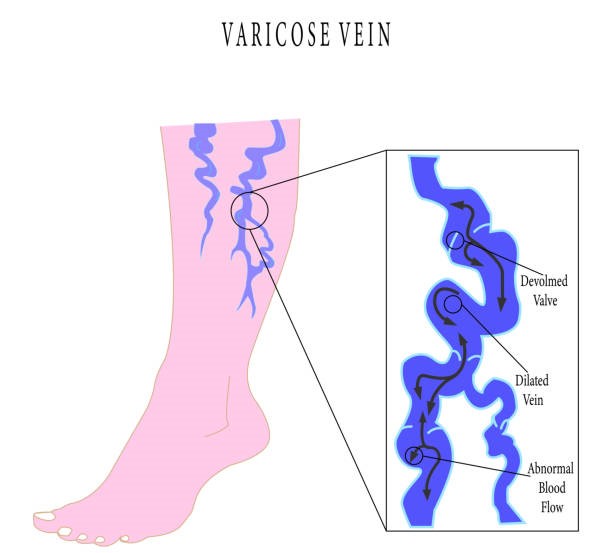
Varicose veins are enlarged, swollen, and twisted veins that are visible just under the surface of the skin, which usually appear blue or dark purple. They occur when the valves in the veins do not function properly, causing blood to flow backward and pool in the vein. This pooling causes the veins to be enlarged. Varicose veins most commonly develop in the legs and feet due to the pressure of standing and walking.
Veins have one-way valves that prevent blood from flowing backward. When these valves become weak or damaged, blood can flow backward and pool in the veins, leading to varicose veins.
Swollen, twisted veins, often blue or dark purple.
Aching or heavy feeling in the legs.
In the lower legs and ankles.
Discoloration, hardening of the vein, or development of ulcers.
Around one or more of the veins.
Sensations in the legs.
Weak or Damaged Valves: Veins have valves that prevent blood from flowing backward. When these valves are weak or damaged, blood can pool in the veins.
Age: Aging causes wear and tear on the valves in the veins.
Pregnancy: Increased blood volume causing pressure on veins from the growing uterus and high levels of estrogen hormones in pregnancy can destroy vein valves.
Age: Risk increases with age.
Gender: Women are more likely to develop varicose veins, partly due to hormonal changes.
Family History: A family history of varicose veins increases the risk.
Obesity: Excess weight puts additional pressure on veins.
Prolonged Sitting or Standing: Long periods of standing or sitting can restrict blood flow.
The doctor will examine your legs while you’re standing to check for swelling.
To see if the valves in your veins are functioning normally or if there’s any evidence of reversal of flow within the veins and quantity for reflux.
Varicose veins can be effectively managed and treated through a combination of lifestyle changes and medical treatments.
Conservative Medical Management offers variety of lifestyle changes including:
Regular physical activity can improve circulation.
Maintaining a healthy weight reduces pressure on the veins.
Specially designed stockings that apply pressure to the legs, helping veins and muscles move blood more efficiently. They can help reduce symptoms and prevent the progression of varicose veins.
Take breaks to move around.
Maintaining a healthy weight reduces pressure on the veins.
Raising your legs can help improve blood flow.
Minimally Invasive Procedures focus on modern non-surgical techniques to seal off the damaged veins, which then redirect the blood to healthy veins. A few common procedures are:
A solution is injected into the varicose veins, causing them to collapse and fade. This is effective for small to medium-sized varicose veins and spider veins.
Non-invasive and effective for medium to large veins, this uses laser energy to close off smaller varicose veins and spider veins.
A foam solution is injected into the vein, causing it to close off. This is effective for small to medium veins with large tributaries.
A catheter is inserted into the vein, and radiofrequency energy is used to heat and close off the vein. This is minimally invasive with a short recovery time.
This is a non-thermal procedure used to treat varicose veins that combines mechanical and chemical treatments to close a vein.
Exercise Regularly:Promotes healthy blood flow.
Maintain Healthy Weight: Reduces pressure on veins.
Elevate Your Legs: Improves blood flow.
Avoid Tight Clothing: Prevents blood flow restriction.
Wear Compression Stockings: As recommended by your doctor.
We specialize in providing care of venous vascular care with a focus on patient safety, comfort, and personalized care. Our team of experienced doctors are experts in the field, utilizing state-of-the-art technology and techniques to deliver exceptional outcomes for our patients.
We understand that considering treatment for venous disease can be daunting. Our compassionate healthcare team is here to guide you through every step of your journey, from initial consultation to post-procedure follow-up care. We prioritize clear communication, education, and patient empowerment to ensure you make informed decisions about your health.
© 2025 created by Nexus Web Creation